cptphilpegley@gmail.com | 813-416-6296 | 1214 Frisbie Rd., Ruskin, FL, 33570

Florida Duck Hunting: Why Boats Matter
Discover why boat hunting is essential for Florida duck hunting in Tampa Bay. Learn about vessel types, positioning, blind setup, and safety for a successful waterfowl hunting experience.
Phil Pegley
4/8/20268 min read
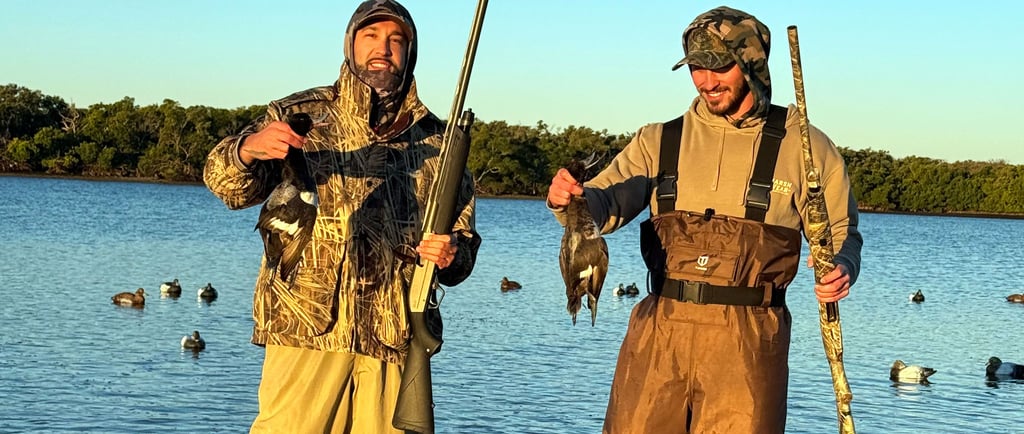
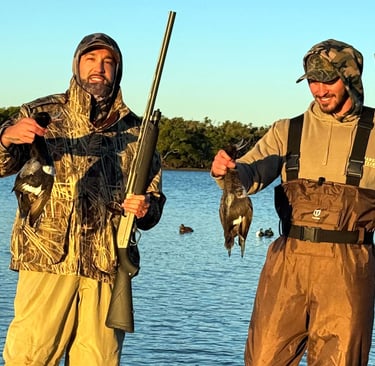
There's a reason the most productive duck hunters on Tampa Bay aren't hunting from shore. Florida's premier waterfowl habitat — the tidal estuaries, open bay flats, mangrove edges, and seagrass beds that diving ducks depend on through the winter — is simply not accessible on foot. The birds live on the water. To hunt them effectively, you need to be on the water too.
Boat-based duck hunting isn't just one approach among many in Florida. For coastal and bay hunting, it's the dominant method — the one that puts hunters in front of birds consistently, season after season. Here's why it works, what kinds of boats are used, and what a properly equipped hunting vessel looks like in practice.
Why Florida Duck Hunting Is a Boat Hunter's Game
To understand why boats dominate Florida waterfowl hunting, you have to understand the habitat. Tampa Bay is a tidal estuary — a partially enclosed coastal body of water where saltwater from the Gulf of Mexico mixes with freshwater from inland rivers and streams. Estuaries like Tampa Bay are among the most biologically productive ecosystems on earth, and that productivity is exactly what draws diving ducks south by the thousands every fall.
The seagrass beds, oyster bars, tidal flats, and open water of Tampa Bay provide the aquatic vegetation, mollusks, and invertebrates that Bluebills, Buffleheads, Redheads, and Ring-necked Ducks feed on throughout the winter. But these feeding and loafing areas are distributed across miles of open water and shallow flat — terrain that's inaccessible from any road, any boat ramp parking lot, or any stretch of public shoreline.
Add to that the nature of diving ducks themselves. These aren't mallards that will work a flooded ditch at the edge of an agricultural field. Scaup and Buffleheads want open water with depth and visibility. They raft in open bay, they feed on tidal flats, and they move along bay points and channel edges as wind and tide shift throughout the day. If you're not mobile — if you're fixed to a shore blind or a public bank — you're hunting where the birds aren't.
A boat changes all of that. It gives you access to the productive interior flats, the bay points where diving ducks concentrate on a northwest wind, and the ability to reposition mid-morning if birds shift. That mobility, combined with the ability to set a proper decoy spread in open water, is why boat hunting consistently outperforms every other method for Florida coastal waterfowl.
Types of Boats Used for Florida Duck Hunting
Not every boat is suited to Tampa Bay's particular demands. The hunting environment here — shallow tidal flats, sometimes open water with wind chop, the need for quiet pre-dawn running, and the practical requirements of a hunting blind — narrows the field considerably. Here's how the main boat types compare.
Jon Boats
The Jon boat is the traditional workhorse of duck hunting across much of the country. Flat-bottomed, stable, and relatively affordable, a Jon boat in the 14–18-foot range is adequate for sheltered marsh and creek hunting. They pole or push quietly into position, handle decoy deployment well, and can be rigged with simple blind frames and natural vegetation for concealment.
The limitation on Tampa Bay is open-water performance. A small Jon boat in any kind of wind chop becomes uncomfortable and potentially unsafe for hunters and equipment. They work well in protected backwater hunting situations but aren't the vessel of choice for the open bay work that defines Tampa Bay's premier diving duck hunting.
Airboats
Airboats are genuinely impressive pieces of equipment for navigating Florida's shallow marshes, Everglades systems, and grass-choked impoundments where a propeller-driven boat simply can't operate. For hunters pursuing mottled ducks, teal, or other marsh species in South Florida's interior wetlands, an airboat opens up territory that's completely inaccessible otherwise.
The trade-off is noise. An airboat is loud — aggressively, unmistakably loud — which limits its utility in hunting situations that require quiet approach and concealment. They're tools for access, not for sitting quietly in a blind while ducks work a decoy spread. For Tampa Bay's open-water diving duck hunting, an airboat isn't the right tool.
Shallow-Draft Skiffs — The Right Tool for Tampa Bay
The shallow-draft skiff is the purpose-built solution for Florida's coastal duck hunting, and it's what Captain Phil Pegley runs on Tampa Bay. A well-designed skiff in the 20–24-foot range combines the shallow-water capability needed to access tidal flats with enough hull to handle the open bay safely when conditions get sporty. It can be run fast enough to reach distant hunting areas before first light, positioned quietly once on site, and rigged as a functional hunting blind.
This is the boat type that defines serious Tampa Bay duck hunting — and it's worth understanding in some detail what makes one work well for the purpose.
Captain Phil's 23' Carolina Skiff: Built for the Bay
Captain Phil operates a 23-foot Carolina Skiff — a platform that exemplifies why the shallow-draft skiff dominates Florida coastal duck hunting. The Carolina Skiff design is legendary in Florida boating circles for good reason: it combines a remarkably shallow draft with genuine stability and enough freeboard to handle open-water conditions that would be uncomfortable or dangerous in a smaller vessel.
At 23 feet, this is not a small boat. It provides a stable shooting platform for multiple hunters, room to manage a full decoy spread and retrieval operations, and the size to run comfortably across Tampa Bay in pre-dawn darkness without beating up everyone aboard. The hull can push through the skinny water of tidal flats that would ground a deeper-draft vessel while still performing confidently in open bay conditions.
The Hunting Blind
What transforms a fishing skiff into a duck hunting platform is the blind system. Captain Phil's boat is fitted with a purpose-built lookout and hunting blind — a raised framework draped with camouflage netting that breaks up the boat's profile against the horizon and provides hunters with concealment while still allowing clear shooting lanes in multiple directions.
The blind serves two purposes simultaneously: it hides the hunters and the boat from approaching birds, and it provides an elevated vantage point for reading bird movement across the bay before legal shooting time. Spotting a raft of Bluebills working toward your spread from 400 yards is only possible if you have the visibility to see them coming — and the raised platform that Captain Phil's blind provides is purpose-built for exactly that.
The netting and blind frame are designed to break up the boat's silhouette against shoreline vegetation or open sky, because incoming ducks are looking for anything that doesn't belong. A boat-shaped object sitting on flat water will flare birds every time. A low, broken profile that blends into the bay's visual texture gives working birds the confidence to commit.
The Firearms
Captain Phil's operation keeps Remington and Winchester shotguns aboard for clients who don't bring their own — a practical accommodation that lowers the barrier to entry for first-time waterfowlers or out-of-state hunters who can't easily travel with firearms.
Remington and Winchester represent two of the most trusted names in American shotgun manufacturing, and both produce field-proven waterfowl guns in 12-gauge configurations appropriate for the diving duck hunting Tampa Bay offers. For open-water diver hunting — where shots at Bluebills and Buffleheads can be fast and at moderate range — a reliable semi-automatic or pump in 12-gauge with a modified or improved-modified choke is the standard setup.
All shells used must be steel or other approved non-toxic shot — federal law prohibits lead shot for waterfowl hunting, and any reputable guide operation enforces this without exception. Captain Phil's clients are briefed on this requirement before the hunt, and no one gets in the boat with lead shells.
Positioning and Safety on the Water
Running a boat in pre-dawn darkness on Tampa Bay, deploying a decoy spread in moving tidal water, and managing multiple hunters with loaded firearms requires both experience and deliberate attention to safety. These aren't concerns that experienced guides treat as an afterthought — they're built into every aspect of how the operation runs.
Safe Boat Positioning
The hunting position is chosen based on wind direction, tidal flow, bird movement patterns, and available cover. Captain Phil positions the boat so that birds approaching the decoy spread will be flying into the wind — which means they're moving more slowly and committing more confidently — while presenting hunters with safe shooting lanes that don't put the boat, the guide, or other hunters in the line of fire.
On Tampa Bay, this typically means tucking against a shoreline, grass flat edge, or structure that provides background concealment for the blind while keeping shooting lanes open over the decoy spread. The boat is anchored or staked in position before legal shooting time begins, giving birds time to accept the setup as part of the landscape.
Pre-Dawn Running Safety
Getting to the hunting area before first light means running a boat in darkness. Captain Phil knows Tampa Bay's navigation hazards — shallow bars, crab trap floats, other vessel traffic, and the markers and channel edges that define safe running routes — as thoroughly as any captain operating in these waters. Clients should expect to run with navigation lights on, at speeds appropriate to visibility conditions, with everyone seated and secured during the transit.
Firearm Safety in the Blind
In a confined boat blind with multiple hunters, firearm handling discipline is non-negotiable. Guns stay unloaded and actions open until legal shooting time and the captain's signal. Hunters know their shooting zones — safe arcs of fire that don't sweep other hunters or the captain. No one mounts a gun until birds are committed and the call to shoot is given.
These aren't suggestions. They're the rules that keep everyone safe and that any experienced guide enforces consistently, every hunt, without exception.
Weather Awareness
Tampa Bay's weather changes. A calm pre-dawn launch can become a 20-knot wind situation by mid-morning, and an experienced captain monitors conditions continuously throughout the hunt. If conditions deteriorate beyond safe operating parameters, the hunt ends and the boat goes in. No duck, no limit, no day's hunting is worth a safety compromise on open water.
Captain Phil monitors forecasts before every hunt and builds contingency plans — alternate locations in more protected water if bay conditions become untenable, earlier wrap times if weather moves faster than predicted.
Why Boat Hunting Simply Works Better
Pull it all together and the case for boat-based duck hunting on Florida's Gulf Coast is straightforward: the birds are on the water, the productive habitat is on the water, and the most effective hunting is on the water. Shore-based hunting in this environment is a significant handicap — you're hunting the margins of where birds want to be rather than the heart of it.
A properly equipped hunting skiff like Captain Phil's 23' Carolina Skiff — fitted with a purpose-built blind, stocked with quality firearms, and run by a captain who knows Tampa Bay intimately — is the platform that gives hunters genuine access to what Tampa Bay's diving duck population has to offer. The boat isn't incidental to the experience. It's the foundation of it.
The birds that winter on Tampa Bay — Bluebills, Buffleheads, Redheads, Ring-necks, Ruddy Ducks, Black-bellied Whistling Ducks — are here because the bay provides exactly what they need. A boat gets you to where they are. The rest is hunting.
Get on the Water with Captain Phil
Duck Hunting Charters operates out of Ruskin, Florida, running morning and afternoon hunts on Tampa Bay throughout Florida's fall and winter waterfowl season. Small groups, a purpose-built hunting platform, and the local knowledge that comes from years on these specific waters.
Contact Captain Phil to book your hunt:
📞 813-416-6296 | ✉ captphilpegley@gmail.com | duckhuntingcharters.com
All hunters must hold a valid Florida hunting license, Florida waterfowl permit, Federal Duck Stamp, and HIP certification. Non-toxic shot required — no exceptions. Verify current requirements at myfwc.com.
© 2025. All rights reserved. Site design by

