cptphilpegley@gmail.com | 813-416-6296 | 1214 Frisbie Rd., Ruskin, FL, 33570

Duck Hunting in Florida vs. Other Southern States: Why Tampa Bay Surprises Everyone
Everyone knows Louisiana. Everyone talks about Arkansas. But Tampa Bay? That one surprises people — and that's exactly the point. We break down how Florida duck hunting stacks up against the South's biggest names, and why more hunters are quietly making it their new favorite destination.
Phil Pegley
4/8/20265 min read
Ask any die-hard waterfowler where they're headed this season, and you'll hear the usual answers: Louisiana's flooded timber, Arkansas's rice fields, or maybe a lease somewhere in East Texas. Florida? That one usually draws a skeptical look — or an outright laugh.
It's a fair reaction, if you've never actually hunted here.
The truth is, Florida duck hunting has a reputation problem. Most people picture crowded boat ramps, warm weather that never quite feels like duck season, and a species list that doesn't stack up to the Mississippi Flyway giants. And if you're chasing greenheads in flooded cornfields, they're right — Florida isn't that.
But if you're willing to think differently about what duck hunting can look like, Tampa Bay will absolutely change your mind.
The Honest Comparison: Florida vs. the Big Three
Louisiana: The Gold Standard — and Its Trade-offs
Louisiana is, by almost any measure, the benchmark for Southern duck hunting. The flooded crawfish fields and cypress swamps of the Atchafalaya Basin hold enormous concentrations of mallards, teal, pintail, and gadwall. Limits are common. The culture is deep. If you want the quintessential Southern duck hunting experience, Louisiana delivers.
But it also delivers crowds, pressure, and the kind of public land competition that can make a great-looking spot feel like a parking lot by opening day. Premium private leases can run several thousand dollars per gun per season. And when the weather doesn't cooperate — which happens more than people admit — those birds can be tight-lipped and frustratingly uncooperative.
Louisiana is hard to beat at its best. It's also hard to justify at its worst.
Arkansas: The Mallard Mecca With an Asterisk
When the conditions align — cold pushing birds south, flooded rice fields loaded with grain — Arkansas hunting in the Grand Prairie or Bayou Meto region is the stuff of legend. Limits of greenheads before 8 a.m. It happens.
It also requires a very specific set of conditions that isn't guaranteed, a significant travel investment for most Southeast hunters, and access to private land or a solid WMA draw to avoid the shoulder-to-shoulder crowds that plague the most famous public grounds. The highs are as high as anywhere in the country. The variability is also very real.
Texas: Big State, Big Variety, Big Challenges
Texas is its own category. The Pineywoods, the High Plains playas, the coastal marshes — the state is so geographically diverse that generalizing is almost pointless. Coastal Texas near the Gulf can produce excellent diving duck hunting with species mixes that actually parallel what we see in Tampa Bay.
The challenge is access. A lot of the best Texas waterfowling is locked behind private ranch gates. Public land pressure in high-quality areas is significant. And the sheer size of the state means travel logistics matter a lot depending on where exactly you're hunting.
Where Florida — and Tampa Bay Specifically — Flips the Script
Here's what most hunters from outside Florida don't know: the Tampa Bay area sits at the intersection of a genuinely productive migratory flyway corridor and one of the most unique coastal hunting environments in the country.
The species mix is legitimately impressive. Forget the idea that Florida only gets the birds nobody else wants. Tampa Bay and the surrounding coastal flats regularly host buffleheads, lesser and greater scaup, ring-necked ducks, redheads, ruddy ducks, hooded and common mergansers, and black-bellied whistling ducks. These are quality birds that challenge your identification skills and your shooting.
The whistling ducks alone — acrobatic, social, and vocal — provide a kind of action that hunters from other states find genuinely novel. They're not mallards, but they're exciting in their own right, and they come to decoys in a way that makes for memorable shooting.
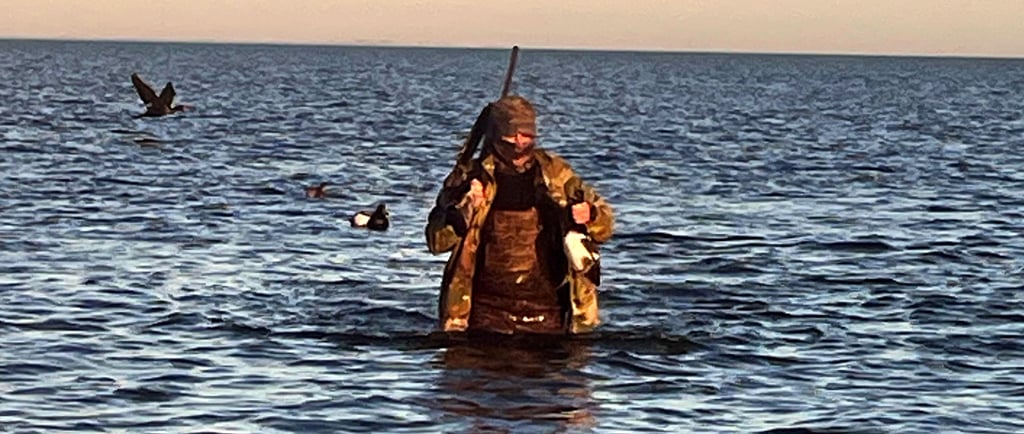
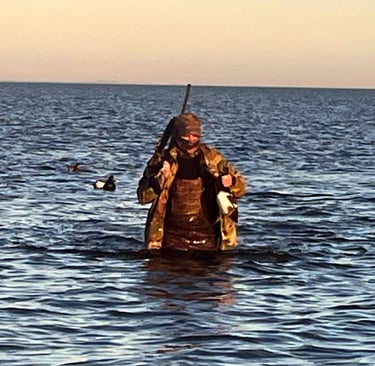
The boat hunting experience is unlike anything in the Upper South. This is the biggest differentiator, and it's the reason Tampa Bay hunting surprises people who come expecting to stand in a flooded field. Hunting from a low-profile boat across open bay flats, poling quietly through shallow grass beds, working birds on open water — it's a different discipline entirely.
Captain Phil Pegler at Duck Hunting Charters has built an entire operation around this style of hunting. The tactics are adapted to the environment: careful boat positioning, understanding tidal movement and wind direction, reading how birds are working the open water versus the mangrove edges. It rewards hunters who are willing to learn a new approach, and it produces results that regularly leave clients stunned.
The season timing offers something the rest of the South can't. Florida's duck season typically runs from mid-November through late January, with specific split dates that vary by zone. What this means practically is that you can plan a Tampa Bay hunt during windows when birds that have been pressured hard in states to the north have pushed further south and are sitting in Florida waters. The birds that show up here in December and January have often run a gauntlet of hunting pressure — and they're still huntable in an environment that doesn't see the same volume of hunter traffic.
The climate is a feature, not a bug. Yes, Florida winters are mild compared to Arkansas in January. Some hunters see that as a drawback. But consider what mild weather actually means for a trip: you're not dealing with boat-freezing temperatures, sleet, or the misery of setting decoys in near-freezing water at 4 a.m. Tampa Bay hunts in December and January are cold enough to be comfortable and invigorating without being punishing. For hunters who want the experience without the physical ordeal, that matters.
Access and pressure are incomparable. The Tampa Bay backcountry simply doesn't receive the hunting pressure that a top-tier Louisiana or Arkansas spot does. Captain Phil knows these waters the way a surgeon knows anatomy — the specific flats, the productive tidal creeks, the spots that hold birds when the wind shifts. That local knowledge, applied to a low-pressure environment, produces consistent results.
The Honest Bottom Line
If you're ranking pure numbers potential at peak conditions in a peak year, Louisiana and Arkansas belong at the top. That's not an argument worth having.
But duck hunting is about more than limit potential. It's about the experience, the environment, the challenge, and the quality of the hunt itself. It's about having a guide who genuinely knows where the birds are and how to work them. It's about coming home with stories you haven't told before — because you've done something you haven't done before.
Tampa Bay checks those boxes in ways that catch people off guard. The hunters who come here expecting nothing and leave planning a return trip — that's not a rare outcome. It happens regularly.
Florida duck hunting isn't what you think it is. If you've been dismissing it as a fallback option or a novelty, you're missing out on one of the most distinctive and genuinely productive hunting experiences the South has to offer.
And Captain Phil is ready to prove it.
Book your Tampa Bay duck hunting charter at duckhuntingcharters.com
Duck Hunting Charters operates out of Ruskin, Florida, offering morning and afternoon guided hunts on Tampa Bay and surrounding tidal flats. Captain Phil provides shotguns, ammunition, and all equipment — you just show up ready to hunt.
© 2025. All rights reserved. Site design by

